The Samilia team was present in Bucharest on Wednesday and Thursday, where Sylvie Bianchi, Project Manager at the Samilia Foundation, gave a conference on the role of the private sector in combating human trafficking. The event was organized by the Romanian Chamber of Commerce — more specifically by its representative, Alain Schodts — in collaboration with the Wallonia-Brussels Federation.
It is not considered Human Trafficking
if the employee was aware… if…
In Romania, the minimum wage is around €320 per month, while the cost of living continues to rise and is getting closer to the Belgian level. Poverty is therefore the main factor that pushes the most vulnerable citizens into the traps of human trafficking. In their struggle to survive, they accept inhumane working conditions, cross borders, and fall victim to prostitution networks. The Global Slavery Index, a study conducted in cooperation with the Australian organization Walk Free, the IOM, and the ILO, estimates that more than 80,000 people are victims of exploitation in Romania.
Having a decent job and a fair wage is one of the essential conditions to fight against human trafficking. This is why it is crucial to raise awareness among companies about the importance of an ethical production chain at every level — from raw materials to finished products.
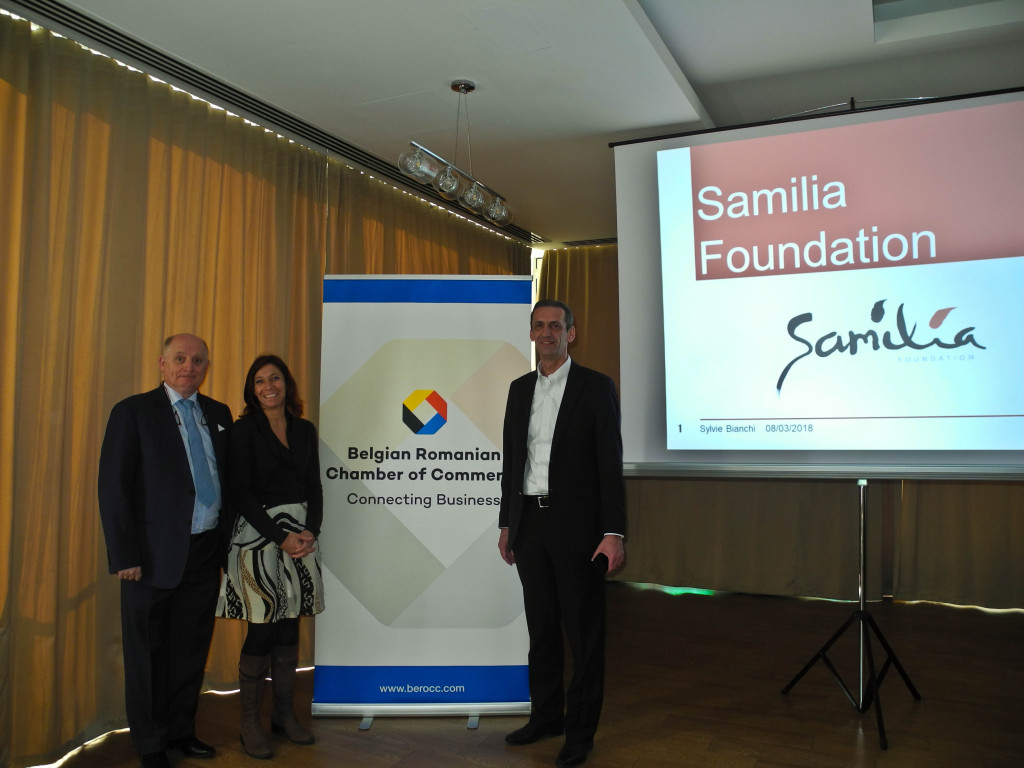
H.E. Thomas Baekelandt (Belgian Ambassador to Romania), Sylvie Bianchi (Samilia Foundation), and Vassilis Stavrou (CEO Mega Image – Delhaize Group)
Invited by the Romanian Chamber of Commerce, several Belgian companies, representatives of business chambers active in Romania, as well as Belgian officials (H.E. Thomas Baekelandt – Ambassador, Machteld Cattrysse – Consul, Eric Poppe – Wallonia-Brussels Delegate General) attended the event. An attentive audience, curious to learn about their power to counter exploitation. In a spirit of trust, the presentation quickly became a conversation — everyone expressing themselves, questioning ideas, reassessing perspectives, and turning shared experiences into sources of inspiration.
A company that pays more for an ethical subcontractor
can no longer keep up with the competition
Profit — the primary rule of the market — is the main concern when discussing an ethical economy. How can one remain competitive if they pay more than a less scrupulous competitor? The answer lies with the consumer. In recent years, citizens have become increasingly attentive to the origin of the products they buy. An ethically labeled product, even if more expensive, reassures the customer. With the omnipresence of social media, consumer trust is not to be taken lightly. At the slightest suspicion of negligence in its production chain, a brand may find itself publicly condemned.
Companies are beginning to realize that “we cannot afford it” is no longer a valid excuse — and that is very encouraging. The fight against human trafficking requires a collective response. Private sector, policymakers, and consumers — only together can we put an end to it.

