Europe: Together Against Human Trafficking
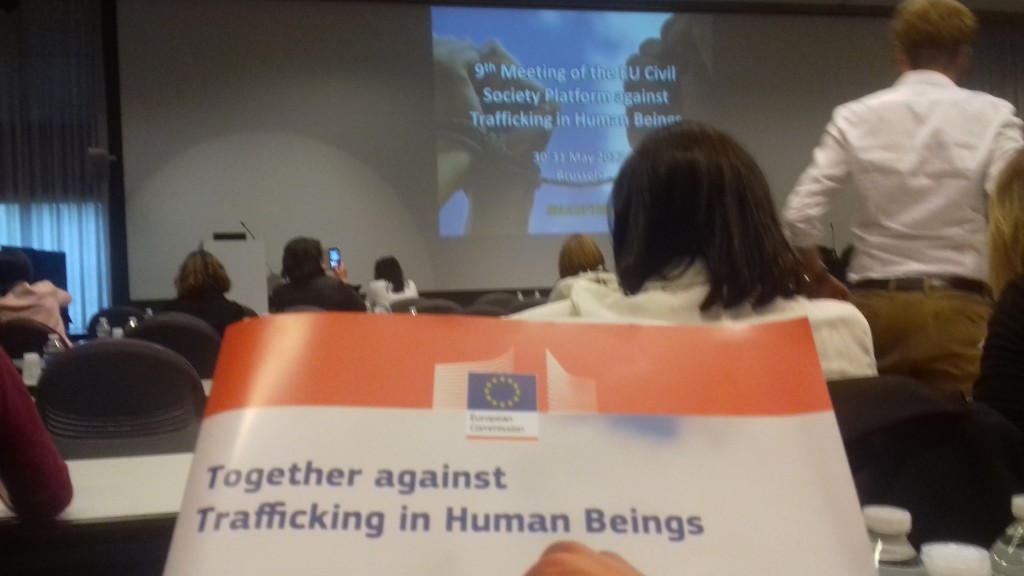
Last week, the European Commission hosted the 9th meeting of the European Civil Society Platform Against Human Trafficking. This biannual event brings together European organizations engaged in combating human trafficking for a series of seminars — an ideal opportunity to exchange insights and identify solutions together.
The seminar in which Samilia participated focused on the links between violence against women and human trafficking. It is alarming to note that 75% of victims are women and girls, and that the majority are trafficked for sexual exploitation.
So, could combating violence against women be a crucial step toward ending exploitation?
All organizations participating in the seminar reported the same observation: although violence against women is increasingly condemned, it remains widely overlooked by citizens. Many still believe that women are partly or fully responsible for the violence committed against them — despite the fact that a majority (84%) of the population (all genders included) agrees that such violence must be criminalized.
Moreover, the violence experienced by women who are exploited (assault, rape, abuse of vulnerability) is very often similar to the violence suffered — to varying degrees — by women in everyday life. Tackling these daily forms of violence is essential to fighting human trafficking, especially since frontline organizations see a direct correlation between the two: the same groups of women — financially or emotionally vulnerable — are targeted.
Finally, the normalization of violence against women often pushes victims into silence, preventing them from reporting abuse. This makes it difficult to gather accurate statistics.
And who are the exploiters?
European statistics on human trafficking provide extensive information on victims (numbers, gender, age, nationality, etc.), but far less on traffickers and on those who create demand. So the question remains: who are the perpetrators? And, more broadly, what is the impact of Europe’s deeply rooted patriarchal norms in enabling exploitation and silencing victims?
It is essential to recognize that the exploiter is not only the person who profits financially from victims, but also the clients — that is, the demand side. They are an integral part of the system. If prostitution is still not universally recognized as violence, it is because many prejudices persist regarding men’s so-called “needs” for sexual access. Considering these “needs” as a necessity effectively decriminalizes — even encourages — sexual violence by excusing aggressors (e.g., marital rape). And yet, such violence has been criminalized for many years (except in Russia, where domestic violence has been decriminalized). Are citizens not ready to take the next step — to acknowledge prostitution (including “voluntary” prostitution) as a form of violence?
Prevention: a key step toward eradicating trafficking
Overall, prevention efforts remain insufficient, while they should be at the core of government and NGO actions to combat both violence against women and human trafficking.
More specifically, all NGOs point to a critical lack of prevention and awareness related to migration. This population — whose numbers have surged following conflicts in the Middle East — is the most vulnerable to trafficking networks, even before reaching European borders. Fleeing war or poverty, weakened by the journey, often unable to communicate with locals, unaware of their rights, and needing immediate income to survive — they fall easily into the hands of exploiters. Another alarming fact: in shelters for UAMs (Unaccompanied Minors), many children go missing. Most of those who disappear are girls, raising strong suspicions of child sexual exploitation networks. Another alarming fact: in shelters for UAMs (Unaccompanied Minors), many children go missing. Most of those who disappear are girls, raising strong suspicions of child sexual exploitation networks.
Public institutions (police, social workers) also do not always recognize human trafficking as violence against women, simply because their training does not include this dimension. Better training is therefore urgently needed, as many legal proceedings fail due to insufficient evidence or a lack of support for victims.
Different Countries, Different Realities
Portugal
Most formally identified victims are men (forced labor sector), although the majority of potential victims are women. NGOs report limited public funding for: 1) identifying victims formally, and 2) directly assisting them.
There is a lack of national strategy to combat gender inequality. In addition, the legalization of prostitution has led to an increase in sex tourism.
Netherlands
Women identified as “voluntary” sex workers are not the majority in the sex industry. Unfortunately, since prostitution was legalized, it is no longer perceived as violence by society.
Poland, and generally Eastern European countries
Over the past 16 months, the newly elected government has caused a concerning setback in women’s rights. However, most officially identified victims are men — around 40% are exploited through forced labor, a sector mainly affecting men. These victims generally come from extremely fragile backgrounds and have already been exposed to violence.
Regarding sexual exploitation, NGOs observe that this issue does not receive sufficient attention from the authorities. In general, sexual violence is often trivialized. Worse still, as women’s rights have regressed, authorities have drastically cut the funding allocated to the protection of women and children.
Ces 16 derniers mois, l’arrivée au pouvoir du nouveau gouvernement a été marquée par un recul alarmant des droits des femmes. Mais c’est tout de même parmi les hommes qu’on trouve le plus de victimes. En effet, 40% d’entre eux le sont dans le cadre du travail forcé, un secteur qui touche principalement les hommes. Les victimes sont des personnes issues de milieux extrêmement précaires et ayant déjà subi des violences.
All these observations were submitted to the European Commission, which will take them into account for future directives and calls for projects. The Commission reiterated that combating human trafficking remains a top priority in Europe and that their efforts will not diminish.
Beyond this institutional collaboration, what we will remember most is the powerful sense of solidarity felt during these two days of work. It is often discouraging to see that this violation of human rights persists despite the relentless work of organizations. Yet, witnessing so many people — many traveling great distances — share their knowledge brings immense hope.We are not alone. A movement is growing. And the commitment of those driving it forward will, one day, put an end to this crime.

