Bet4Life, an initiative of the Samilia Foundation

Bet4Life, an initiative of the Samilia Foundation

( 0 out of 5 )

This initiative aims to highlight the dark side of an extraordinary sporting event: human exploitation and trafficking. This campaign is in no way intended to be directed against the World Cup or any other sporting event. It is a campaign that denounces the crimes committed in the shadows. The World Cup attracts millions of fans. Unfortunately, most of these supporters are unaware that behind the smiles, the celebrations, and the breathtaking skills, some unscrupulous individuals take advantage of the situation to commit appalling atrocities: forced begging, forced prostitution, forced labor, and human trafficking. This campaign juxtaposes the thrill of the game with the horror of human exploitation. It contrasts the excitement of sports betting with the despair of human trafficking victims. The tone is deliberately provocative: betting on human suffering is horrific, we all agree. But this approach allows us to confront realities that will coexist for a month: the reality of the World Cup and that of individuals who treat others as merchandise, as currency for their own profit.

It is essential to raise awareness among the general public and political authorities about the need to enforce existing laws, as well as to alert them to new forms of human trafficking: the ingenuity of traffickers knows no bounds, and human trafficking now affects all sectors of economic life. As for the victims, they no longer come exclusively from distant countries, since 65% of victims registered in Europe are residents of a European Union member state. Finally, it is important to remember that the crime of human trafficking does not require crossing a border: one can be a victim of human trafficking in one’s own country.

The FIFA World Cup attracts millions of fans and supporters. Unfortunately, most of them are unaware that behind the smiles, the celebrations, and the breathtaking skills, some unscrupulous individuals are exploiting the situation to commit appalling crimes related to human trafficking in the shadows. Mass gatherings are, in fact, a boon for traffickers, allowing them to exponentially expand their lucrative criminal business in a very short period of time.

Therefore, and in order to fulfill its role of raising awareness and educating the general public—with the greatest possible impact and to change attitudes and behaviors on these essential issues of citizenship and democracy—the Samilia Foundation decided to launch a hard-hitting campaign on the eve of the 2018 FIFA World Cup in Russia, developed in partnership with the creative team at the J. Walter Thompson Brussels communications agency.

This extensive awareness campaign focused on the various forms of human trafficking that violate fundamental human rights, particularly prevalent in the context of mass sporting events:

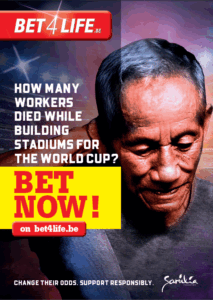
  • Forced labor, one of the most significant forms of human trafficking, is rampant, notably during the construction of stadiums hastily erected for major sporting events. These “workers,” in reality slaves, sometimes pay the ultimate price: for example, 19 men forcibly recruited in North Korea perished during stadium construction in Russia;
  • Sexual exploitation, which affects 67% of human trafficking victims and is intrinsically linked to gender: 95% of victims of trafficking for sexual exploitation are female;
  • Exploitation through forced begging, which affects not only adults but also a large number of children, sometimes from communities already widely discriminated against and in situations of great vulnerability, such as Roma populations;
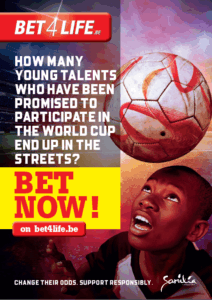
  • And, finally, the exploitation of young football talents, mainly from West Africa, recruited by pseudo-agents to fulfill their dream of playing for a “big club,” finding themselves undocumented and sometimes indebted to the tune of several thousand euros with no possibility of returning to their country of origin.

Created with the support of the Belgian Football Association, the Bet4life campaign was in no way directed against the World Cup or any host country, but rather aimed at denouncing the crimes committed in the shadows by unscrupulous individuals who exploit the opportunity to boost their revolting businesses: forced begging, forced prostitution, forced labor, and player trafficking in football.

Bet4Life is a mock online betting site where the focus is not on betting on football matches, but on the lives of children, women, and men who are victims of human traffickers.

The tone is deliberately provocative: betting on human suffering is horrific, we all agree… But this approach allows us to confront realities that coexist during a specific period: in this case, the reality of the World Cup with its celebrations and breathtaking technical feats, and that of individuals who treat others like merchandise, currency for their own profit.

This campaign is an invitation to celebrate sport responsibly, to say NO to all forms of abuse, and to promote fair play and the civic values ​​inherent in living together.

The objective, from this perspective, was to engage the public and invite them to react, illustrating, through contrasts, the excitement associated with sports betting and the despair of victims of human trafficking.

Actions of this awareness campaign

1.   June 14, 2018: Launch of the website www.Bet4life.be

A campaign website with a design identical to that of a real sports betting website was created: www.Bet4life.be.

It was officially launched on the same day as the FIFA World Cup. The visuals on this website are intentionally realistic and come in four different images, each corresponding to one of the four most common forms of human trafficking encountered during major sporting events:

  • Forced child begging;
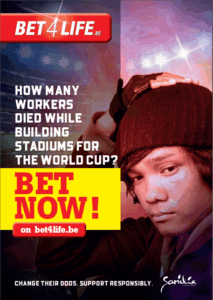
  • Exploitation through forced labor during the construction of sports stadium infrastructure;
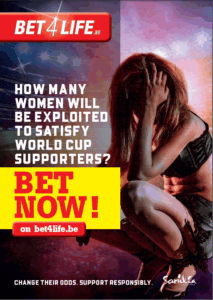
  • Organized sexual exploitation surrounding these events;
  • Exploitation through football, perpetrated by unscrupulous recruiters who ensnare unsuspecting young players, particularly from Africa, lured by the dream of a better life.

Bet4life’s betting options aren’t about the matches and teams participating in the World Cup, but about the realities surrounding the tournament that are often ignored. The message is deliberately provocative:

“Bet on the number of children who will be forced to beg during the World Cup”

“Bet on the number of migrant workers who died building the stadiums”

“Bet on the number of young women who will be exploited to satisfy fans”

“Bet on the number of young footballers promised a place in the World Cup who ended up on the streets”

The objective is to engage the public and encourage them to consult relevant information, delivered in the form of short thematic videos, on human trafficking accompanying major sporting events, and to adopt a responsible and attentive supporter behavior that respects fundamental human rights and the civic values ​​that underpin the community.

2.   June 19 – July 2: Display of visuals in the Brussels metro and in football clubs

The four visuals that make up the Bet4life campaign, measuring 1.80m x 1.20m, were displayed in 39 Brussels metro and pre-metro stations: Albert, Alma, Anneessens, Bizet, Botanique, Bourse, Comte Flandres, Crainhem, De Brouckere, Delacroix, Delta, Demey, Eddy Merckx, Erasme, Etangs Noirs, Gare Centrale, Gare de l’Ouest, Gare Midi, Gare Nord, Hermann-Debroux, Horta, Hotel des Monnaies, Josephine-Charlotte, La Roue, Louise, Maelbeek, Merode, Montgomery, Parc, Petillon, Porte de Hal, Rogier, Roodebeek, Saint Guidon, Trône, Yser, Veeweyde, Belgica, and Arts-Loi. In total, an estimated 280,000 users per week were exposed to the campaign’s message encouraging responsible behavior and directing them to visit www.bet4life.be, where more comprehensive information on human trafficking is available.

Subsequently, from mid-August to mid-October, these posters were displayed in various football clubs: Standard Liège, Sporting Club Charleroi, and Royal Excel Mouscron, as well as in the social welfare centers (CPAS) of the municipality of Saint-Gilles and at key locations in Charleroi and Mons (the Labour Prosecutor’s Offices in Charleroi and Mons, and various bars and restaurants in downtown Charleroi).


3.   June 16–June 27: Radio spot broadcasts

Three 30-second radio spots, each illustrating one of the forms of human trafficking addressed in the Bet4life campaign, were broadcast on DH radio. The tone of these audio clips is intentionally hard-hitting. These spots were broadcast 84 times during the campaign period, at a rate of six spots per day. IMU visuals (300×250 format) were also displayed on the DH Radio website for seven days.

4.   June 26 – July 12: Distribution of 70,000 GUIDOOH/Boomerang cards in the French Community of Belgium

Featuring the four visuals of the campaign, 70,000 GUIDOOH cards were distributed across the territory of the Wallonia-Brussels Federation: Brussels, Wavre, Bierge, La Hulpe, Rixensart, Genval, Ceroux-Mousty, Louvain-La-Neuve, Lasne, Lasne-Chapelle-Saint-Lambert, Nivelles, Waterloo, Braine-l’Alleud, Mont-Saint-Guibert, Nil-Saint-Vincent-Saint-Martin, Liège, Wandre, Angleur, Chênée, Herstal, Boncelles, Jemeppe-sur-Meuse, Juprelle-Slins, Housse, Namur, Belgrade, Bouge, Gran-Marnil, Naninne, Erpent, Charleroi, Gosselies, Gilly, Mons, Ghlin, Tounai, Ramegnies. This action made it possible to reach a very wide audience and encourage them to visit the website www.bet4life.be to obtain relevant information on human trafficking in the context of major sporting events and to adopt a responsible supporter behavior that is attentive to fundamental rights and collective civic values.


5.   August 30 – September 10: Screening of Bet4life videos at the Venice International Film Festival

The distribution of the Bet4life campaign videos on social media caught the attention of the organizers of the Venice International Film Festival, who decided to screen them on the large screen behind the red carpet used by actors as they entered the screening rooms. The four videos were shown 24 times a day during the 11 days of the festival, which amplified the campaign’s impact and gave it international exposure.


6.   From August 10th to October 18th: Display in Belgian football clubs

To extend the Bet4life campaign’s reach beyond the World Cup period, the SAMILIA Foundation extended its reach: in collaboration with various football clubs, the bus shelter posters that had been placed in the metro were displayed in the fan shops of Standard Liège, Sporting Charleroi, and Waasland-Beveren, in connection with the Jupiler Pro League. The target audience was clearly identified: the active supporter, with the aim of promoting fair play and respect for civic values.


This campaign is an invitation to celebrate sport responsibly, to say NO to all forms of abuse, and to promote fair play and the civic values ​​inherent in living together.

The objective was, therefore, to engage the public and encourage them to react, illustrating, through contrasts, the excitement surrounding sports betting and the despair of victims of human trafficking.

The decision to launch the campaign as a fake online betting site was driven by the abundance of betting websites that appeared during the FIFA World Cup. It was guided by the desire to give the campaign a popular format and appeal, directly connecting it to the habits of fans and placing it at the very heart of the target audience’s private lives.

Initially, the fake online betting site “Bet4life” offered fans, football betting enthusiasts—or the general public—the opportunity to bet not on the national team’s first goal, but on the lives of children, women, and men who were victims of human traffickers. It bears repeating that the “merchandise” of this vile trade—human trafficking—are particularly vulnerable people, easily exploited under threat, fear, and degradation.

This initial phase allowed, in a second stage, for visitors to be informed concretely about the conditions of exploitation faced by victims of each of the forms of trafficking explored. The aim was to encourage them to question what lies behind the glory and glitz of major sporting events and to raise their awareness of the need to respect human rights.

The objective was therefore, in parallel, to shift attitudes towards the role of fans and the general public at sporting events, with the goal of fostering a more critical perspective on the appalling living conditions of thousands of victims of human trafficking—anonymous faces encountered at the sites of exploitation for profit, sometimes criminally, during the festivities associated with major sporting events. It was also intended to empower them in their roles as citizens and consumers. Indeed, once informed and aware of the issues behind the apparent smiles of victims, consumers of services or products with a high potential for human trafficking, such as those targeted by the campaign, can contribute to a fairer world by deciding, for example, not to fuel the scourge of sexual exploitation through forced prostitution or forced begging. The exploitation of people in the construction sector and the exploitation of young African players in football serve as examples that raise awareness and prompt consumers to take action regarding the phenomenon of economic exploitation in general, not just in the construction or football sectors. The aim is to raise awareness of exploitation through forced labor in all sectors of economic life where human trafficking is prevalent, such as the agri-food sector, the textile sector, cleaning, cosmetics, hospitality, Horeca, etc.

COLLABORATIONS/ PARTNERSHIPS

URBSFA (Royal Belgian Football Association): competition and overall support for the campaign

STIB: provision of advertising space in the Brussels metro: following the success of the 2017 campaign in the metro, STIB became aware of the issue of human trafficking and offered poster visibility at cost price (media value €11,480)

JWT: creation and production of visuals, website, and videos

JC DECAUX: printing of posters in bus shelter format

GHIDOOH: offer of a significant discount on the base price

Since the launch of the campaign, the SAMILIA Foundation, which had already established partnerships with field associations providing various forms of assistance to football players who are victims of human trafficking, has been approached by various actors in the field, such as SPORTA, FRIENDLY FOOT ASBL, HAUTE ECOLE CONDORCET, in order to benefit from its experience and to jointly implement new projects related to it.

DEVELOPING AWARENESS/CRITICAL ATTITUDE

The primary goal of the awareness campaign, aimed at the general public and football fans, was to inform potential customers/consumers about the real risks of exploitation in the services or products they buy or consume. The Bet4Life campaign sought to raise awareness among fans, as well as all citizens, about this issue, which intensifies during major sporting events but is also prevalent in our daily lives, and whose existence and/or extent are unknown to many.

Secondly, this increased awareness acts as a catalyst for greater consideration of the collective values ​​that form the common foundation of democratic societies, leading to the adoption of ethical and conscious consumer behaviors that respect fundamental human rights. Every citizen has an important role to play in building a more just and dignified world for all.

QUANTITATIVE EVALUATION

  • 42,681 views of the campaign’s posts and website via Facebook.
  • 36,000 views of the interview with Sylvie Bianchi, project coordinator, on the Paris Match website.
  • 84 airings of the audio clips on DH radio over two weeks (average listenership of 100,000 per week, therefore an estimated 200,000 listeners reached).
  • 560,000 estimated views of the posters in the metro.

In short, this campaign is an invitation to celebrate sport responsibly and to say no to all forms of abuse.

Thank you for your support.

The Samilia Foundation Team