The Loverboy Phenomenon
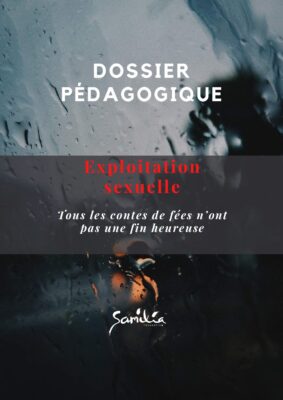
A loverboy is a human trafficker who recruits women and girls in order to sexually exploit them. Using various techniques of seduction and manipulation, loverboys exert control over their victims and make them dependent, ultimately forcing them into prostitution. Taking advantage of the victims’ vulnerability and naïveté, the method used by loverboys constitutes human trafficking, whose ultimate purpose is always exploitation.
The loverboy’s strategy is typically the same: presenting himself as a charming man wishing to build a relationship, he pretends to start a romantic love story with his future victim in order to gain her trust. He uses various lures: promises of a better future, expensive gifts to seduce the victim, emotional manipulation, and psychological blackmail… Social media are increasingly used as recruitment tools.
If many young women targeted by loverboys are brought to Belgium, particularly from countries of the former Eastern bloc, a significant number of Belgian victims is also recorded each year.
Victims of loverboys are most often young women from socio-economically precarious backgrounds, with personal histories marked by stays in youth welfare institutions or juvenile justice centers. However, victims also include teenagers from more affluent or middle-class backgrounds. As for young women of foreign origin exploited sexually in Belgium, most of them have been trapped by a loverboy.
Each victim’s life story is unique. However, their fragility often stems from common factors: the desire for a better life, low self-esteem, and emotional vulnerability.
Several signs may indicate that a young woman is under a loverboy’s control: the presence of a new, very controlling and possessive “boyfriend”; the sudden appearance of money from an unknown or unclear source; increasing isolation from family and friends; proposals for travel or work abroad; sudden loss of interest in school; consumption of illegal substances; traces of physical violence…
Among the continuum of gender-based violence, the sexual exploitation of women and children continues to thrive in an almost total indifference to the torture, physical abuse, and psychological suffering endured by the victims.
Our Tools and Actions
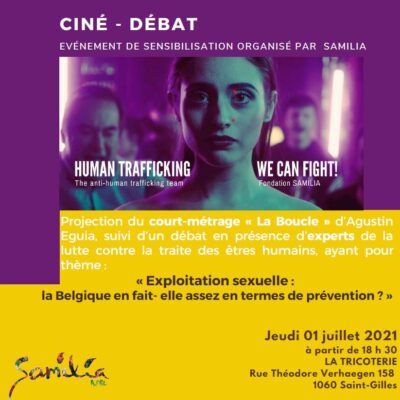
Sexual Exploitation: Is Belgium Doing Enough in Terms of Prevention?
European law requires EU Member States to implement information and awareness-raising policies, as well as prevention measures, to reduce the risk of people becoming victims of human trafficking. Among these obligations is the adoption of appropriate measures to discourage and reduce the demand for services, including sexual services, that result from exploitation (Art. 18 of EU Directive 2011/36/EU).
To debate this issue, Samilia will organize — as soon as sanitary conditions allow in 2021 — four screening-debate events with experts from NGOs specialized in supporting victims of human trafficking, gender equality, the judicial sector, and the political sphere.
The first screening-debate will take place in Brussels at La Tricoterie (date to be confirmed). The following events will be held in several cities in Wallonia (Louvain-la-Neuve, Liège, Namur, or Charleroi).
Educational Toolkit
What to Do?
IN CASE OF IMMEDIATE DANGER TO YOURSELF OR A MINOR: CONTACT THE POLICE AT 112 (FREE NUMBER IN BELGIUM)
Contact a Specialized Center for Victims of Human Trafficking:
| Brussels: Pag-Asa Address: Rue des Alexiens 16b, 1000 Brussels Tel: +32 2 511 64 64 WhatsApp: +32 470 940 777 Email: info@pag-asa.be |
For minors: Esperanto Address: confidential for victims’ safety Tel: +32 473 400 066 Email: contact@esperantomena.org |
| Liège: Surya Address: Rue Trappé 9, 4000 Liège Tel: +32 42 324 030 Email: info@asblsurya.be |
Antwerp: Payoke Address: Leguit 4, 2000 Antwerp Tel: +32 (0)3 201 16 90 Email: TraffickingLBTP@payoke.be |
Useful Numbers and Websites on Missing or Exploited Minors
Reporting missing or exploited minors: Child Focus helpline: 116 000 (free)
Reporting cases of child sexual exploitation abroad: jedisstop.be
Other Specialized Services for Violence
Brussels Sexual Assault Care Centre (CPVS)
(7 days/week, 24h/24)
320 Rue Haute (CHU Saint-Pierre), 1000 Brussels
Tel: +32 (0)2 535 47 14
Domestic violence helpline
(7 days/week, 24h/24, free and anonymous): 0800 30 030
Spanish-language helpline for victims of violence
(Mon–Fri, free): 0800 55 552