A study on groups at high risk of human trafficking, launched by the European Commission in 2015, reveals that the extent to which a person is vulnerable to trafficking is rarely determined by a single factor, but rather by a combination of circumstances that make them victims of trafficking. Four main groups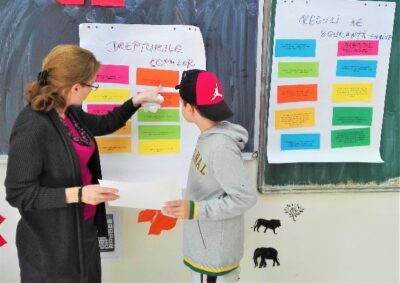 of factors were mentioned, namely: individual, familial, socioeconomic, and structural. These factors include a history of abuse and a vulnerable emotional state, often attributable to a dysfunctional family situation, supported by material deprivation, family breakdown, a lack of positive attachment relationships within the family, extreme poverty, low levels of education, surviving in sub-substantial conditions, an inability to create a more positive environment that would allow access to decent living conditions, repeated experiences of abuse and discrimination in the labor market, and the perception that the situation cannot be improved. For many, these factors lead those vulnerable to human trafficking to believe that working abroad could be the answer to a better life. This dream often translates into taking high-level risks; levels of desperation can reach such extremes that any offer is interpreted as an opportunity to improve their current situation.
A very large proportion of the young women sexually exploited in major Western European cities – and regularly transferred from one capital to another by their traffickers – come from the former Eastern Bloc countries, and particularly from Romania or border towns. Many of them are still minors when they are recruited by human trafficking networks, which lure them using various techniques such as the “lover boy” trap or under the guise of false promises related to a future change in social status or a sham job (modeling, hospitality, care work, beauty treatments, etc.).
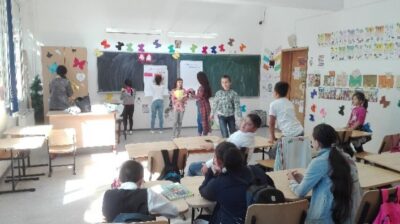
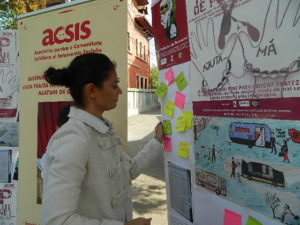
During the first workshops held in a vocational high school in partnership with the Bucharest School Inspectorate, the boys showed great interest in the information provided by the psychologist of ACSIS is addressing young girls in order to warn them of the traps set by pimps.
The boys wanted to take an active part in the discussion because they didn’t see themselves in this role of exploiters, a role they disapproved of.
From there, we adapted the program to actively include the boys in our prevention efforts in two ways.
Prevention aimed at potential perpetrators, prevention of the risk of becoming victims of economic (and even sexual) trafficking themselves
As a result, boys, although not themselves immune to sexual exploitation, are most often recruited for precarious, low-skilled jobs in conditions akin to slavery across diverse sectors such as transportation, construction, and manual labor. The increase in social inequalities and school dropout rates among young people, leading to intense precarity in certain communities, can also result in their exploitation in networks of forced begging or involvement in petty crime.
The overall objective of the project, implemented by the partner NGO ACSIS under the guidance, coordination, and supervision of Samilia, is to reduce human trafficking by increasing the empowerment and defense capabilities of the aforementioned at-risk groups, as well as by drastically raising awareness of this scourge among members of their communities.
It targets three different groups, identified as being at particular risk due to their high vulnerability and precarious living conditions.
The project’s overall objective is to reduce human trafficking by increasing the empowerment and defense capabilities of these target groups, as well as raising their awareness. In terms of impact, the “STOP PERSONAL TRAFFICKING” project has raised awareness since 2009 in Bucharest, Ploiesti, and Chisinau (Moldova), reaching 5,641 students in technical and vocational high schools, 242 teachers and educators, and 428 young mothers, pregnant women, and children.
The project’s coordinated areas of intervention are as follows:
 Peer-to-peer prevention program within technical and vocational high schools:
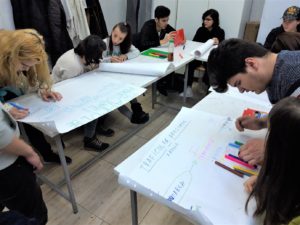
This program, aimed at preventing human trafficking in its various forms, with a specific focus on sexual exploitation, is designed for students—both girls and boys—in technical and vocational high schools, as well as their teachers and educators. After intensive training on the topic (10 two-hour training sessions for 16 young people, teachers, and educators) and having been provided with training tools using a peer-to-peer methodology, these students, in turn, organize human trafficking prevention workshops in their high school classrooms.
The receptiveness of the students sensitized in these classrooms is increased because prevention is carried out by peers (horizontally) and in light of concrete situations encountered in the field, rather than by an authority figure or an organization external to the school. Having been trained in this way, all the students are appointed “ambassadors” in the fight against human trafficking within their own communities of origin, which allows for a widespread dissemination of awareness among vulnerable populations.
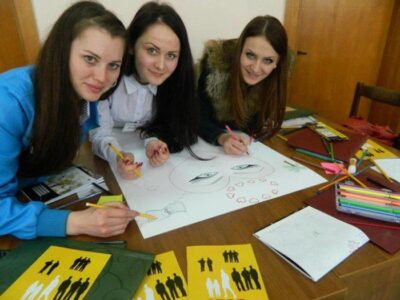
The objectives of this training
> Reduce vulnerability and risks related to human trafficking by raising awareness and training young people about the risks and consequences involved.
> Equip participating students with specific and in-depth knowledge, as well as tools to use, through a peer-to-peer methodology, to raise awareness and train their peers about the risks of human trafficking.
> Raise awareness on a broader scale within communities about the dangers of human trafficking.
The training workshops cover a wide range of topics: definitions, recruitment phases, profiles and recruitment methods of human traffickers, the “lover boy” tactic, victim profiling, and self-protection strategies against traffickers, with a specific focus on the dangers of using social media and the safety rules to observe.
These workshops gave participating students the opportunity to share their own experiences, some of whom had been dangerously approached by individuals using fake profiles on Facebook. After receiving and learning the content of the “Stop trafficking” manuals, the students also watched videos explaining the lover-boy phenomenon.
positive factors for change
The session revealed several positive factors contributing to behavioral change, both for the students trained to become trainers (peer-to-peer training) and for the 270 students who completed the final training:
> Increased self-esteem, confidence in public speaking, positive appreciation of self-reflection during exercises, enhanced active listening and participation skills, a non-judgmental attitude, and respect for diverse viewpoints. However, some exercises also presented challenges, bringing to light memories of childhood traumas for some participating students.
> A significant increase in students’ overall understanding of the mechanisms and consequences of human trafficking, as evidenced by the evaluation of final questionnaires completed after the various workshops and the provision of clarifications or further details in response to student questions;
> Student engagement and seriousness regarding the issue of human trafficking.
Prevention program for young pregnant girls or those who are already mothers, many of whom are minors, living in precarious situations: A growing number of these young women, abandoned by their child’s biological father and rejected by their own families, leave Romania for Western Europe, leaving their children behind in the care of a friend, neighbor, or acquaintance. Unfortunately, many fall prey to human trafficking networks. To combat this phenomenon and allow these young women to raise their children with them, the prevention program provides specific support for young single mothers, including basic necessities, psychosocial support, and training to facilitate their access to local employment while raising awareness of the risks associated with human trafficking. The program also ensures that the child receives proper medical care and education.
Testimonies collected“The training was a unique experience for me; I learned a lot, it was very useful, and I’m very happy to have had the opportunity to be a part of it.” N.A., student
“When I had to give my presentation, I felt like I didn’t know anything and I just wanted to leave. It was very difficult at first, but then I relaxed and was able to speak. I think I did well; my classmates applauded me.” S.I., student
“This training was very useful for me because, unfortunately, these days there are people who are dangerous and seek to harm others. I understood that this world is not as we might imagine it. Some things can affect both our freedom and ourselves as human beings, especially us, the younger generation.” E.P., student
Prevention program for disadvantaged children aged 6 to 12: as easy targets for human traffickers, the prevention program aimed at disadvantaged children – from poor and isolated (often single-parent) families – the program takes the form of several group sessions of up to 20 children. It emphasizes children’s rights to psychological and physical integrity, develops their ability to identify potential threats to this integrity, and trains them in safety rules to adopt, particularly on social media and with their direct or indirect social circle.
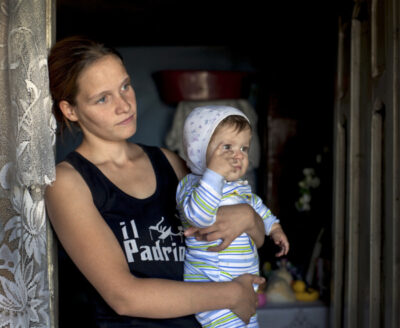
Iona, 20, has an eight-month-old daughter. She is separated from the child’s father, who was a drug addict.
She shares a two-room apartment with her mother, her sister, and her sister’s husband in Bucharest.
In the hope of a better life, Iona risks falling into a prostitution ring. – Mashid Mohadjerin
 .
. 
✓ Increase children’s knowledge of their rights
✓ Increase children’s ability to understand and identify violations of their rights
✓ Train children on safe practices on social media.
The first workshop begins with a presentation on the board about children’s rights and safe practices, particularly on social media. The children are then asked, one by one, to distinguish between a child’s right and a safe practice, and to list them in two separate columns.
Next, the children were asked to name behaviors that violate their rights. In this context, the children elicited responses related to child abduction and violence against children, allowing the facilitator to explain the risks associated with human trafficking and the smuggling of children forced to work, beg, or drop out of school, only to be taken from their families, manipulated, or kidnapped. They are then taught that respecting safety rules protects them from human rights violations.
We want to take meaningful action to prevent even more young girls from falling into the traps of prostitution rings. In collaboration with the Romanian NGO ACSIS, since 2009 we have been conducting prevention work targeting a specific audience of pregnant girls and mothers.
Responding to a real need, this initiative has been expanding since 2008 to include final-year students from several vocational high schools in Bucharest, currently reaching approximately 7,000 young people (directly and indirectly) and 65 teachers/educators each year.
The goal of this project is to empower vulnerable individuals to defend themselves against human exploiters.
The target audience consists of at-risk youth, considered as such because they come from impoverished backgrounds or dysfunctional families.