Youth prevention in the Federation Wallonia-Brussels

Youth prevention in the Federation Wallonia-Brussels

( 0 out of 5 )

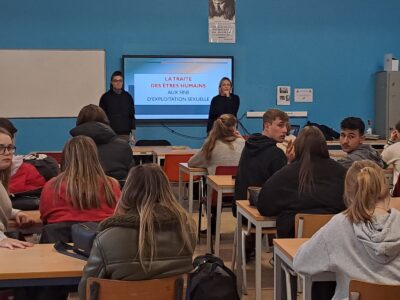
The Samilia Foundation is currently carrying out an awareness-raising project on sexual exploitation among young people in schools, supported by the Equal Opportunities Directorate of the Ministry of the Fédération Wallonie-Bruxelles. This project aims primarily to inform and raise awareness, but also to prevent a relatively young audience from becoming involved in human trafficking, sexual exploitation, and the loverboy phenomenon. Young people represent a particularly vulnerable target group on these issues. In practical terms, our interventions take place over two consecutive class hours, which can be organized by the class teacher or any teacher interested in addressing this topic.

In order to ensure these sessions run smoothly, a preparatory meeting is organised either in person or via video call with the teachers involved. This allows us to listen to the teacher regarding the needs or specificities of their students in relation to the topic. As soon as the intervention deals with issues related to sex and prostitution, we ensure that the content and format of our presentation-discussion are appropriate for the targeted classes.

Broadly speaking, Samilia’s intervention is preceded by a short anonymous individual questionnaire and consists of an exchange with the students using several educational tools, including:

  • The screening of our short film “La Boucle” (5’36) on the Loverboy phenomenon: https://youtu.be/Z6Dl35OcwW8
  • A “question-and-answer” card game – to deconstruct stereotypes and misconceptions related to sexual exploitation and prostitution
  • A PowerPoint presentation to introduce and contextualize the broader issue of human trafficking

This video is produced by the Belgian company 87 Seconds, with support from Wallonie-Bruxelles International and the Culture Department of the Fédération Wallonie-Bruxelles. It has also received the sponsorship of the UNODC Blue Heart Campaign. On June 10, 2020, Samilia received the First Prize – in the category “organizations active in the social-profit sector” – at the Video Experience Day competition by AP Hogeschool Antwerpen for this short film.

By the end of December, the Samilia Foundation will have informed 1,000 students in the Fédération Wallonie-Bruxelles about the realities of human trafficking, particularly sexual exploitation through “loverboys”, the new generation of pimps operating on social media.



International conventions equate the “prostitution” of minors with human trafficking for the purpose of sexual exploitation. However, the omnipresence of social media among young people, combined with widespread access to online pornography and the increasing normalization of paid sexual interactions, leads many teenagers to view prostitution as “a job like any other.”
Some underage girls, regardless of their social background, even see prostitution as a pleasant and lucrative activity that could be carried out without endangering their physical or mental integrity. Samilia is contacted by various schools concerned about the misconceptions their students hold regarding sexual exploitation. A tailored awareness-raising project, including psycho-educational tools, is currently underway for approximately one thousand students. Our team visits schools to inform young people about this topic and warn them of the serious consequences of this unacceptable crime: human trafficking.

A French TV series illustrating the “loverboy” phenomenon is available on TF1+: “Fugueuse – Prostituted by Love”

Fugueuse (serie) | TF1+

Fugueuse tells the story of a descent into hell. Léa is a quiet teenager with a loving family. She loves dancing and dreams of making it her career. One day, however, she falls in love with an older man. Very quickly, she falls under his influence. At first, she believes he will help her achieve her dreams. But he manipulates her. Léa spirals into prostitution and violence.

Post-intervention results

Questionnaires given to students before and after our interventions reveal striking conclusions.

The purpose of Questionnaire A – conducted prior to the workshop – was to assess the students’ preconceived ideas at the end of secondary school regarding trafficking and prostitution, as well as to better understand their views on love and violence.

The initial objective—raising awareness of trafficking and sexual exploitation—was broadened through the collection of very personal student testimonies.

Half of the students did not know what human trafficking consists of. Almost all stated that they found the activity interesting, useful, and that it encouraged them to ask questions and reflect.

Before our intervention, the questionnaires also showed that:

  • Half of the students believe prostitution is usually a well-paid job that allows people to get rich.

  • At the end of secondary school, 1 in 10 underage girls says she might consider prostitution to make ends meet.

  • Basic notions concerning rape are unclear for 4 out of 10 students.

  • Nearly one quarter of the students trivialize violence within a relationship.

  • Slightly more than 1 in 20 believe using violence against women is an acceptable option.

The purpose of Questionnaire B – completed after the workshop – was to gather feedback regarding our intervention and collect any testimonies of sexual cyberharassment.

In fact, nearly one third of underage students – mostly girls – report having already faced explicit and paid sexual propositions online.

Just over 3 out of 10 students state they have already been victims of sexual cyberharassment, and we received numerous testimonies confirming this.

In the digital age, social media platforms have been taken over by sexual predators targeting minors. It is not easy for young people to deal with repeated propositions for paid sexual acts, which are often explicit from the outset. For their safety and mental well-being, it is essential that they have a space to share their experiences and discuss them with trained professionals.