The Cocoa Supply Chain
Do you know under what conditions the cocoa beans in your chocolate were harvested?
Cocoa: The Brown Gold
West Africa produces a large portion of the world’s cocoa. Ghana and Ivory Coast are the two main cocoa-exporting countries, together representing 60% of global cocoa production. Belgium produces around 600,000 tons of chocolate per year (equivalent to 300,000 tons of cocoa beans). Nearly 75% of the chocolate consumed in Belgium comes from these two countries. Belgium is therefore one of the largest importers of cocoa beans and the second-largest exporter of chocolate in the world.
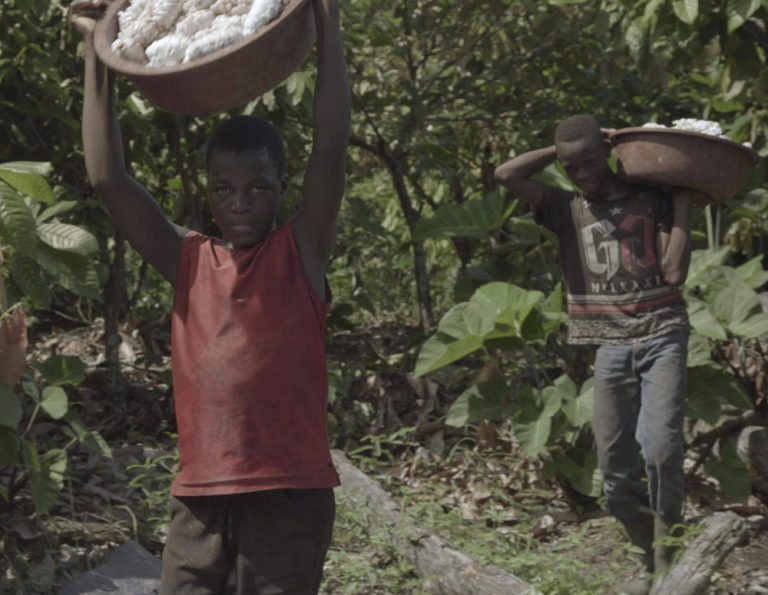
The Cocoa Industry: Journey of a Bean in Ivory Coast
Cocoa is indispensable in Ivory Coast. To supply 40% of the global market, this sector mobilizes nearly one million producers, providing income for five million people—roughly one-fifth of the country’s population. Cocoa is the country’s leading source of foreign currency and holds a central place in Ivorian society.
And yet! Despite its enormous influence, the cocoa sector does not fully play its role as a driver of economic development. Some even speak of the “brown gold curse.”
Three facts prove this:
- The majority of producers live on less than €0.67 per day.
- Expanding cultivated areas causes massive deforestation (which has decreased from 12 million hectares in 1960 to less than 3 million today).
- Ivory Coast has not yet managed to increase its share of profits (which stagnate between 5% and 7%) along the global cocoa-chocolate supply chain.
Most plantations are small (between 2 and 5 hectares) and produce between 350 and 650 kg per hectare. To give a sense of scale, a plantation would need 15 hectares of cocoa to reach a living income given current prices, yields, and production costs… far from sufficient.
The Problem of Intermediaries in the Cocoa Chain
Most farmers lack modern agricultural machinery, and their plantations are poorly maintained, with aging trees yielding fewer fruits. Many producers live in remote regions with poor roads, making access and transport of beans difficult, and they critically lack transportation means. With no alternatives, they sell to collectors who buy at prices below the already low market rates. To date, there is no control system or licensing for these collectors.
These collectors then sell the beans to cooperatives, which cannot produce enough to meet global cocoa demand. The Ivorian government estimates that 40% of farmers are organized into cooperatives. This means that 60% of cocoa beans sold come from unidentified areas. Cooperatives in turn sell beans to wholesalers (such as Barry Callebaut, Cargill, Puratos…) who ship them worldwide. The beans are then processed into cocoa butter or powder in factories. Finally, chocolatiers and chocolate companies turn them into bars, spreads, bakery products, candy bars, or pralines using their own recipes, ready to be sold worldwide.
Additionally, cocoa price speculation on stock markets increases the instability of farmers’ incomes. In 2017, cocoa prices fell, and farmers became even poorer.
Question: Did you pay less for your chocolate as a result?
NGOs work to improve the living conditions of cocoa farmers, especially to ensure a living income for West African producers; among them are FairTrade, Oxfam, and Trias.
Note: A living income is an income that allows a family to meet its basic needs, such as a nutritious diet, decent housing with proper sanitation, school fees for children, healthcare, transportation, and some savings.
Yet today, few farmers receive this living income. Beyond extreme poverty, the lack of transparency and traceability of beans remains a major problem in the cocoa sector, which is essential to identify risks of exploitation.
Your support is valuable!
Follow our campaign!
#JeConsommeEthique
Supported by the Continuing Education Service and the General Administration of Culture.

Child Labor in Ivory Coast
Although major industry players committed in 2001 to eradicate child labor in chocolate production and signed the Harkin-Engel Protocol (an initiative of two U.S. Congress members), an estimated 2.1 million children now work in cocoa plantations in Ivory Coast and Ghana. Child labor figures rise with the expansion of cocoa farms.
Focus: Ivory Coast
Approximately 900,000 children aged 10–17 work on Ivorian cocoa farms (Walk Free Foundation, 2018). 86% of these children perform hazardous work on family farms. They attend school little or not at all and carry out tasks that harm their physical or mental health. They spray pesticides without protection, carry overly heavy bags of beans, and handle dangerous tools (machetes). UNICEF adds that these abusive practices are sharply increasing, particularly regarding pesticide use.
Root Causes of Child Labor and Exploitation
The main cause of child labor is poverty. Parents cannot afford school fees and need their children to help on the farms.
Other root causes include:
-
Lack of access to quality education (limited infrastructure, shortage of qualified teachers, some classes with 100 students…): 50% of children in rural areas do not attend school.
-
Lack of identity documents: 40–50% of children in some regions have no ID, preventing them from attending secondary school or accessing basic healthcare.
-
Weak social protection systems.
-
Health issues (malaria, recurrent diarrhea), lack of clean water, and poor nutrition. Girls are particularly affected after puberty due to inadequate infrastructure (no separate toilets, lack of drinking water, etc.).
-
Child exploitation and violence against children.
Samilia’s Commitment
Our team has focused on the little-known scourge of child exploitation in the cocoa industry for several key reasons:
- In 2013 and 2014, the Samilia Foundation conducted prevention projects related to sexual exploitation and exploitation in football in West Africa, particularly in Ivory Coast. These projects helped thousands of families recognize the methods used by human traffickers and protect their children from these traps. (Learn more : football against trafficking et prévention sexuelle en Afrique )
- Building on this expertise and aiming to raise citizen awareness about human trafficking, we decided to better understand the cocoa supply chain, especially in Ivory Coast.
- Furthermore, the Belgian government, particularly Alexandre De Croo, Minister of Development Cooperation, launched the “Beyond Chocolate” program on December 5, 2018, aiming to develop sustainable Belgian chocolate by 2030. The Samilia Foundation is a co-signatory and has played an important role in including human trafficking in the government program.
Despite campaigns highlighting farmers’ precarious conditions and child labor, human trafficking is still largely overlooked in the chocolate industry. Samilia emphasizes the urgent need to eliminate human exploitation in the cocoa supply chain and is exploring field projects in this area
Beyond Chocolate
Belgian chocolate is appreciated worldwide for its quality. In December 2018, under Minister De Croo, the Belgian government launched a sustainability program for Belgian chocolate: Beyond Chocolate.
The program initially focused on three pillars:
-
A living wage for farmers.
-
Fighting deforestation and developing education and eliminating child labor.
Samilia added a fourth pillar:
the tragic problem of human trafficking.
Samilia led the “Youth and Decent Work” working group, contributing to project selection criteria and medium- and long-term program objectives and indicators. As a result, human trafficking was included on the program agenda. Clearly, the Belgian cocoa chain, like any other, should be free from economic exploitation, whether of adults or children. Our goal concerns global production.
Concrete Outcome: Since Beyond Chocolate aligns with the UN Sustainable Development Goals (SDGs), SDG 8, related to human trafficking, was added.
SDG 8: Promote sustained, inclusive, and sustainable economic growth, full and productive employment, and decent work for all.
8.7: Take immediate and effective measures to eradicate forced labor, end modern slavery and human trafficking, prohibit and eliminate the worst forms of child labor, including child soldier recruitment, and by 2025 end child labor in all its forms.
Beyond Chocolate has numerous signatories from the chocolate industry, retailers, academia, and civil society, including Samilia. Neighboring countries are watching. No other government has yet placed the living income at the center of its sustainable development program. Belgium hopes to inspire others.
The Ivorian government also has major responsibilities in improving living conditions, infrastructure, social protection, education, and fighting corruption. An ambitious program exists to address the worst forms of child labor but needs full support.
A Step Toward Improvement
Some chocolatiers and cocoa companies have already taken initiatives, but these remain isolated and do not always address root causes. A comprehensive approach must include farmers, their families, and communities.
Civil society monitoring Beyond Chocolate demands transparency in the cocoa production chain, with clear mapping from bean to chocolate. Industry and governments must ensure traceability to eliminate grey areas, requiring a multi-sectoral collaboration approach.
Other key actors, such as FairTrade, Oxfam, Trias, ILO, and UNICEF, are working in the same spirit. The challenge is immense.
The Role of Consumers
Consumers also have a voice; chocolate and cocoa purchases create the market, not the other way around! Their choices can influence the industry as a whole.
Learn more about Beyond Chocolate: Link
“Beyond the sectoral federation Choprabisco, retail chains such as Delhaize, Aldi, Lidl, Carrefour, and Colruyt Group commit to ensuring that their private-label brands adhere to this partnership. Belgian universities, governmental and non-governmental development organizations, impact investors, and trade unions also support the new partnership and contribute, within their areas of expertise, to sustainable Belgian chocolate. The initiative also includes non-Belgian chocolate producers. This is important because the cooperation of every actor is necessary to make Belgian chocolate more sustainable and ensure that everyone benefits.
Through Beyond Chocolate, all signatories commit to cooperating on a wide range of challenges related to sustainable chocolate, such as combating deforestation, eliminating child labor, and ensuring a living income for local cocoa farmers. Concretely, all Belgian chocolate, produced or sold in Belgium, must meet a relevant certification standard or be made from cocoa complying with company-specific sustainability programs by the end of 2025 at the latest.
By the end of 2025, partners must also fully comply with the agreements between public authorities and private partners established under the Cocoa & Forests Initiative. The main goal is to end deforestation in the two largest cocoa-producing countries, Ghana and Ivory Coast. Deforestation resulting from cocoa production for the Belgian chocolate sector must cease by 2030 at the latest. By then, all cocoa producers must receive at least a living income.”