
NEW PERSPECTIVES for the UNITED NATIONS Convention
for the Suppression of Trafficking in Human Beings
and the Exploitation of the Prostitution of Others.
Conference in Brussels on September 30, 2013.
In the presence of Her Majesty the Queen
An initiative of the Ministers
Najat Vallaud-Belkacem
&
Joëlle Milquet
New York Convention

The Convention for the Suppression of the Traffic in Human Beings and of the Exploitation of the Prostitution of Others is a resolution of the United Nations General Assembly;
The preamble states:
“Considering that prostitution and the evil which accompanies it, namely trafficking in persons for the purpose of prostitution, are incompatible with the dignity and worth of the human person and endanger the well-being of the individual, the family and the community…”
The Convention was adopted by the United Nations General Assembly on 2 December 1949 and entered into force on 25 July 1951. As of 2012, 82 States had signed the Convention (see map). In addition, 13 other States have also signed the Convention but have not ratified it.
The Parties to this Convention agree to punish any person who, to satisfy the passions of another:
1) Engages, trains or entices another person, even with their consent, into prostitution;
2) Exploits the prostitution of another person, even with their consent.
The Parties to this Convention also agree to punish any person who:
1) Keeps, directs, or knowingly finances or contributes to financing a house of prostitution;
2) Knowingly leases or rents, in whole or in part, any building or other premises for the purpose of the prostitution of others.
The Convention also prescribes procedures to combat international trafficking for the purpose of prostitution, including the extradition of offenders.
Furthermore, the Parties to this Convention undertake, if they have not already done so, to take the necessary measures to monitor employment offices or agencies in order to prevent job seekers, particularly women and children, from being exposed to the danger of prostitution (Article 20). And if any dispute arises between the Parties to this Convention concerning its interpretation or application, and if this dispute cannot be settled by other means, it shall, at the request of any of the Parties to the dispute, be submitted to the International Court of Justice. (Article 22)
Website : United Nations
Link to the full text of the Convention
Organizers
Samilia Fondation
The Samilia Foundation, located in Brussels, was created in 2007 to make the fight against human trafficking a Belgian and European priority. Samilia is active in the areas of combating sexual and economic exploitation.
The Areas of Action of the Samilia Foundation:
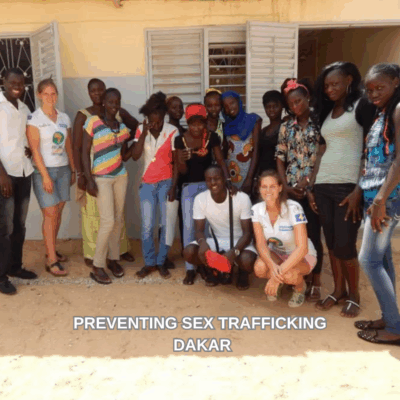
• Prevention in countries of origin (primarily Romania, Bulgaria, Moldova, and Ivory Coast)
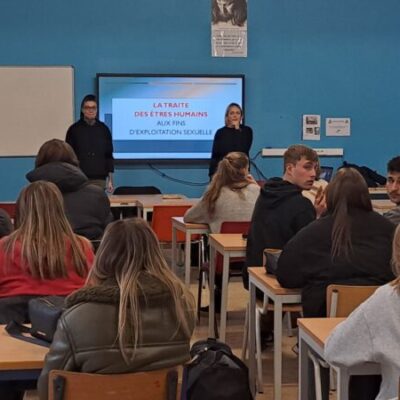
• Awareness-raising in countries of origin and destination
• Social inclusion programs in countries of origin with the Belgian private sector (Delhaize)
• Awareness-raising actions targeting politicians and magistrates and alerting them to emerging trends
• Cooperation in international projects
The Samilia Foundation is in charge of organizing the Conference for Ministers Joelle Milquet and Najat Vallaud-Belkacem, who are keen to put women’s rights at the heart of the political agenda.
Why the 1949 New York Convention?
The 1949 New York Convention for the Suppression of the Traffic in Persons and of the Exploitation of the Prostitution of Others, a resolution of the United Nations General Assembly, remains the only legal text that explicitly addresses the exploitation of the prostitution of others and establishes clear guidelines that States that have ratified the Convention must follow. However, it is clear that many States do not adhere to these guidelines.
The Convention stipulates that the parties to this Convention also agree to punish any person who:
Owns, directs, or knowingly finances or contributes to the financing of a house of prostitution;
Knowingly leases or rents, in whole or in part, any building or other premises for the purpose of the prostitution of others.
The Convention also prescribes procedures to combat international trafficking for the purpose of prostitution, including the extradition of offenders.
Some figures
The ILO report published in June 2012, covering the period 2002-2011, estimates that the number of victims of forced labor, including forced sexual exploitation, reached 20.9 million worldwide, with an estimated 5.5 million children. This estimate is considered conservative. Within the European Union, 880,000 people are trapped in forced labor.
The UNCOD global report of December 2012 estimates the following percentages between 2007 and 2010:
Child trafficking has increased, reaching 27%, compared to an estimated 20% between 2003 and 2006. Gender and age of victims:
Globally, human trafficking for sexual exploitation is more frequent than economic trafficking, although the latter has increased from 18% to 36%.
In Western and Central Europe:
61% are women
15% are girls
20% are men
4% are boys
In Europe and Central Asia:
16% are children
62% sexual exploitation
31% forced labor, slavery, and servitude
Overall:
59% are women
17% are girls
14% are men
10% are boys
Convictions have decreased by 13%.
Given the increase in human trafficking, with a particular focus on sexual exploitation and the exploitation of prostitution, the two Ministers decided to join forces and convene other European Ministers for Equal Opportunities to ensure that combating this type of crime becomes a genuine European priority.
The two ministers, in agreement with the Samilia Foundation, decided to start with objective studies in order to examine the scourge of the exploitation of the prostitution of others from a gender perspective.
Speakers
Sophie Jekeler
A lawyer by training, Sophie Jekeler has worked for 20 years on issues of human trafficking, prostitution, sex tourism, and child sexual exploitation.
Twelve years spent meeting with and providing legal, psycho-medical, and social support to people involved in prostitution have given her an in-depth understanding of the realities on the ground in these areas.
In 2007, the scale of human trafficking motivated her to create the Samilia Foundation to combat this new form of slavery in its two main dimensions: sexual exploitation and economic exploitation.
Thanks to her frontline experience working with people involved in prostitution and her mastery of the Belgian and European legal framework, she is regularly invited to participate in symposiums, conferences, network training sessions, expert groups, and media interviews.
Prioritizing awareness and information on human trafficking, Sophie has organised numerous colloquiums, conferences and study days on the subject, aimed at both the general public and specialized audiences such as magistrates, parliamentarians, journalists, employers’ representatives…
Sylvie Bianchi
Sylvie Bianchi is a Play Therapist. She studied at the Roehampton Institute in London and worked in the field of systemic therapy in the context of family violence for 12 years as a therapist and manager of European projects. She worked at the Marlborough Family Service in St John’s Wood with Dr. Asen and his team in the Family Day Unit, where she developed her knowledge of systemic and multi-family therapy. She then introduced multi-family therapy at the Child Protection Center in Gosselies. She wrote and managed two European Daphne projects in the area of violence against women and children in the family context. She has extensive experience working with vulnerable individuals and at-risk groups in terms of domestic violence. She has also worked as an independent therapist, providing support to children experiencing emotional difficulties while collaborating with their parents in this context. She has organized various conferences and workshops on domestic violence and co-authored a European report (UK, Belgium, France, Italy, Germany, Denmark, Poland) on multi-family therapy in the context of domestic violence, as well as a training DVD on multi-family therapy for professionals (systemic therapists). She also collaborated with Doctors of the World as a Regional Manager on a project addressing violence against women and improving access to healthcare for women working in maquiladoras in Guatemala.
Sylvie has been working with the Samilia Foundation for two years and is now a member of its Board of Directors. She works for Samilia as a consultant on projects related to social inclusion, prevention in countries of origin, and raising awareness about human trafficking. She also engages in fundraising and submits projects to the European Commission. She also holds a degree in English-Russian Translation from the Higher Institute of Translators and Interpreters in Brussels, as well as a diploma in Prenatal and Infant Emotional Support.
She currently works part-time for ECPAT Belgium, where she manages the Belgian component of the European Daphne project “Make-IT-Safe,” which raises awareness and provides training for young people (12-18) on internet safety using the peer-to-peer methodology. The target audience for this project includes unaccompanied minors and students in schools.
Myria Vassiliadou
Ms. Myria Vassiliadou has been in charge of the Anti-Trafficking Coordination for the European Commission since March 2011.
The position of European Anti-Trafficking Coordinator was initially established by the “Stockholm Programme” within the European Anti-Trafficking Directive.
The European Anti-Trafficking Coordinator is responsible for improving coordination and coherence between European institutions, agencies, Member States, and international actors. The coordinator must also develop existing and new European policies concerning human trafficking.
The Anti-Trafficking Coordinator must also ensure and oversee the implementation of the new European strategy « EU Strategy towards the Eradication of Trafficking in Human Beings (2012-2016) » and to propose a political orientation strategy for the European Union’s foreign policy in this area.
Ms. Vassiliadou holds a degree in Sociology and Social Research as well as a PhD in Sociology from the University of Kent at Canterbury, United Kingdom. She was a researcher at the Ash Salomon Centre for the Study of Ethno-Political Conflicts at the University of Pennsylvania. Ms. Vassiliadou served as Secretary General of the European Women’s Lobby, the largest network of women’s organizations in Europe. She was a founding member of the think tank at the Mediterranean Institute for Gender Studies, where she served as Director for seven years and subsequently as Chair of the Board. For over ten years, Ms. Vassiliadou worked as a Sociology Assistant at the University of Nicosia and taught undergraduate and graduate courses in Sociology.
Ms. Vassiliadou previously worked for the European Commission as a National Expert in the Research Department. Furthermore, she has served as a member of various councils and expert groups, and has consulted at both national and international levels. She has worked extensively in the field of fundamental rights, given their connection to issues of human trafficking, gender, migration, ethno-political conflicts, and media. Her work has been published in numerous books and journals, she has led seminars and workshops, and she has been deeply involved in various think tanks, research projects at the European level, and both governmental and non-governmental organizations. She is trained as a counselor on domestic violence against women and as a facilitator and mediator in conflict transformation and negotiations.
Mark Capaldi
Mark Capaldi is the author of the article “Does the Legalization of Prostitution Increase the Sex Trafficking of Women and Children?” (2012).
The purpose of this article is to explore and examine the links between the legalization of prostitution and trafficking for sexual exploitation. He will provide his analysis of the situation from a researcher’s perspective.
Director of Research and Policy
Mark Capaldi has long been an advocate for vulnerable and marginalized children. A specialist in community and humanitarian development, as well as in child rights programs, he has worked with organizations focused on children’s issues, such as street children and child laborers. He has developed projects addressing children in conflict with the law, violence and abuse against children, and the vulnerability of children of internally displaced persons and migrant children. He has worked extensively in Southeast Asia, where he spent 15 years with Concern Worldwide, PACT Inc., and Save the Children UK.
As Executive Director of ECPAT International (2001-2011), Mark Capaldi promoted the work and vision of the ECPAT network with the aim of ending the sexual exploitation of children. Mark supports a range of programs worldwide related to combating child sex tourism, legal reforms, child protection and monitoring, preventing child exploitation through the internet and new technologies, anti-trafficking initiatives, and promoting the participation of young people and children. He has also been involved in developing and strengthening the ECPAT network, fostering collaborations, and advocating for children. He currently serves on the Child Protection in Tourism Code Council.
Since June 2011, Mark Capaldi has worked part-time for ECPAT as Director of Research and Policy. He has also begun a PhD at the Institute for Human Rights and Peace Studies at Mahidol University in Bangkok. His dissertation focuses on the role of children in independent child migration in Thailand.
Hakan Erdal
Hakan Erdal is currently INTERPOL’s Coordinator for Trafficking in Persons. He has served as Secretary General since September 2010. A graduate of the Turkish National Police Academy in 2000, he began his professional career in combating human trafficking in 2004 as head of the Immigration Department’s Police Unit. He currently works on capacity-building projects and coordinates police operations conducted by INTERPOL’s Human Trafficking Unit in various regions of the world.
Hakan will discuss the fight against human trafficking and new technologies. The internet has created a new avenue in our lives that criminals have learned to exploit, like a hidden alleyway to perpetrate their crimes. This hidden alleyway is difficult to monitor in terms of crime prevention, due to numerous reasons, including legislative discrepancies and a lack of resources. Network technology offers vast advertising opportunities for criminals and abusers. This includes targeting potential child trafficking victims during the recruitment phase.
The complexity of various laws governing the internet complicates INTERPOL’s work, as do new methods of victim recruitment via smartphones, social media, and the internet in general. Therefore, it is essential to develop a new, proactive approach to law enforcement regarding this hidden alleyway. The need for intelligence gathering, the collection of potential evidence related to this alleyway, and effective international cooperation are among the cornerstones of this proactive approach.
Evelyne Josse is a psychologist and psychotherapist trained in Ericksonian hypnotherapy, EMDR, and brief therapy. She is a private practice psychotherapist, a supervisor of psychotherapists, a trainer in psychotraumatology, a member of the scientific committee of the Belgian Institute of Victimology, an expert in forensic hypnosis for the Belgian justice system, and vice-president and head of the “Communication” committee of the EMDR-Belgium association.
Since the 1990s, Evelyne Josse has provided psychotherapy consultations to individuals suffering from psychological trauma following sexual abuse and assault. In the 2000s, while working with international humanitarian NGOs, she was responsible for operational research on sexual violence, particularly in the context of armed conflict. She has written numerous articles on sexual and gender-based violence, as well as guides for supporting victims.
Ecrits :
“The Power of Therapeutic Stories,” published in 2007 by Desclée De Brouwer;
“Psychological Trauma in Infants, Children, and Adolescents,” published by De Boeck in 2011; and
“Mental Health Interventions in Mass Violence,” co-authored with V. Dubois, published in 2009 by De Boeck.
She has also written the following articles on the hypersexualization of society:
Pre-prostitution behaviors among adolescents:
http://www.resilience-psy.com/spip.php?article226
Hypersexualized society: the consequences on sexuality
http://www.resilience-psy.com/spip.php?article228
Programme
Inter-Ministerial conference of the 30.09.2013- Palais d’Egmont – Brussels
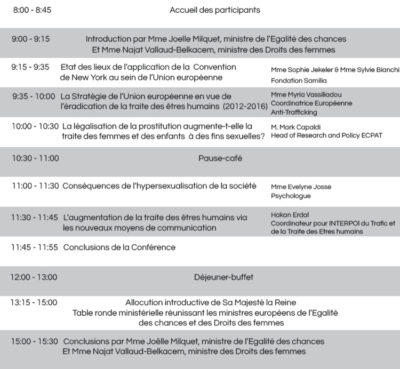
Speakers’ speeches
Address by Her Majesty the Queen
Presentation Sophie Jerkeler & Sylvie Bianchi
Mark Capaldi – Ecpat presentation
Hakan Erdal – La traite des êtres humains et internet
Evelyne Josse – Hypersexualisation